skip to main |
skip to sidebar
Att som i fråga 12 tolka litteratur sägs vara en konst, men ändå undersöks Shakespeare om och om och om igen. En av de mest svårlästa tolkningarna bör dock vara Notes Towards the Complete Works of Shakespeare som skrevs av Elmo, Gum, Heather, Holly, Mistletoe och Rowan - sex celebesmakaker i Paignton Zoo Environmental Park, uppkallade efter bland annat järnek, mistel och rönn. Syftet med deras publikation var, enligt deras skötare, att få till stånd ett svar på en ofta omtalad del av kaosteorin: om man har ett oändligt antal apor framför varsin skrivmaskin, skulle de då kunna skriva ett verk som är oskiljbart från ett skrivet av Shakespeare? Svaret lät naturligtvis inte vänta på sig, även om makakerna förmodligen är lyckligt omedvetna om uppståndelsen. Inom internetkulturen får Andrej Kolmogorovs sats om oändligt antal apor anses som välspridd, men även en aktad författare som nobelpristagaren J.M. Coetzee anspelar på denna i sin roman Elizabeth Costello, vilket även nämndes i frågan. Resultatet då? Jo, efter en viss tvekan i form av ett ff producerades fem sidor text, främst bestående av bokstaven s! De citat - jjjajaajjsss, lnknnbmm och blbbbbnn - som togs från texten, som f.ö. finns tillgänglig på engelska, tyska, franska och spanska, är bland de mer begripliga. Rätt svar: Elmo (22 poäng)
 "Two Bs or not two Bs, that is the question."
(N.B.: the chimp shown here is in no way related to William S.)
To interpret literature is said to be an art of its own as solvers were asked to do in question 12, yet Shakespeare endures a seemingly never-ending supply of re-interpretations. One of the most hard-to-read critiques ought to be Notes Towards the Complete Works of Shakespeare written by Elmo, Gum, Heather, Holly, Mistletoe, and Rowan - six Celebes crested macaques (Macaca nigra) in Paignton Zoo Environmental Park, Devon, UK. The reason with their publication was, their handler said, to reach an answer in a much debated issue with chaos theory: if one has an infinite number of monkeys each in front of a typewriter, could they then write a piece inseparable from one written by Shakespeare? The answer came quickly, although the macaques are happily unaware of the stir they caused. Within the internet culture, the infinite monkey theorem is well-known, but even a highly regarded author as Nobel prize laureate J.M. Coetzee uses his own version of this in his novel Elizabeth Costello, which was also mentioned in the question. So what about the actual result? Well, after some hesitation expressed with an ff a total of five pages were produced, primarily consisting of the letter s! The quotes - jjjajaajjsss, lnknnbmm och blbbbbnn - taken from the text, which incidentally is available in English, German, French, and Spanish, are all excerpts of the less repetitive part. Correct answer: Elmo (22 points)
Rules for Klurendrejeriet® 2009
Correctly filled-in answers
As usual, each question has one (1) unambiguous answer: a number, a concept, or a letter following the text. If a question (contrary to expectation) has more than one solution, choose the one that fits better in the complete solution and the spirit of the contest! For an idea on how a "better" answer should be interpreted, please visit the Klurendrejeriet® archive on the homepage of Ultunesaren.
Selection
Of the twenty-four questions in the contest, you should pick out six (6) to answer when you send in your solution. All questions answered among all participants are tallied and ranked with a descending score, where the contestants with the highest point total will get to the final. If one or more questions have not been chosen by any participant, they will be counted highest. Erroneous answers will not yield penalties, but will be used as a tie-breaker to separate questions with an equal amount of correct answers (the more wrong answers, the harder the question). If there is still a tie between questions, the points between these are split evenly.
Score
The question with the lowest number of correct answers is worth 46 points, then 41, and then 37, 33, 30, 27, 24, 22, 20, 18, 16, 14, 12, 11, 10, 9, 8, 7, 6, 5, 4, 3, 2, and 1 points, respectively.
Address and a tip
Send you answers to: Klurendrejeriet, c/o Ultunesaren, Ultuna studentkår, Box 7074, S-750 07 Uppsala, Sweden so we have it no later than Wednesday January 21, 2009. Make sure you include a phone number where you can be reached on Thursday January 22, 2009 between noon and 2 p.m.. One answer per participant. If you have not solved six questions, guess and send in anyway! Numerous consolation prizes and honors are at stake! Remember that an "easy" question may be worth a lot if no on else chooses to answer it!
Guaranteed seat in the final
To have a chance of reaching the final on February 7, 2009 via the guaranteed seat you must find the correct code in the Media noise, a sifting mechanism that follows four set rules when two answers meet:
even digit and zero beats vowel (even digits: 2, 4, 6, 8)
vowel beats odd digit (vowels: a, e, i, o, u, y, å, ä, ö)
odd digit beats consonant (odd digits: 1, 3, 5, 7, 9)
consonant beats even digit (consonants: non-vowels)
The fill-out form for the Media noise will be published tomorrow. Changes regarding the contest and its rules will be published here on the blog until January 15, 2009.
En del tryckfel har upptäckts i den engelska versionens regler som inte har någon större betydelse för tävlingen, men som meddelas här nedan för att undanröja eventuella misstolkningar. Ändringarna kommer att inkluderas i eventuella framtida versioner av denna tävling.
A few typos have been discovered in the English version of the Rules that do not alter the contest, but are listed below to remove all doubts that may be inferred due to them. These changes will be included in future versions, if released.
18. DANGEROUS LIAISONS?
Rules [Point value]: "... how hard it really ..." & "... a finalist cannot ..."
Rules [Guaranteed final seat]: "... you have a chance to ..." & "... as previously described."
Rules [Extrachansen]: "Submit your answer ..."
Rules [Award ceremony]: "... one must be present and participate in ..."
Rules [Journey to the Unknown]: "... (question 8) ..." & "Send in your answer ..."
Utöver SAOL XIII finns det all anledning att ha ett svensk-engelskt lexikon till hands, framförallt om man vill parallellösa sanningar ur den engelska översättningen av Klurendrejeriet® 2008. Andra böcker som kan tänkas vara nyttiga skulle kunna vara den klassiska The Blue Book of Chess, den nya finlandssvenska Sånger för alla och möjligen Stardust: the ***** ***** Story (för inspiration).

In every library?
I varje bibliotek?
In addition to SAOL XIII, there is a good reason to have a Swedish-English dictionary handy, especially if one wants to scoop parallel truths from the Swedish original version of Klurendrejeriet® 2008. Other books that may be useful could be the classic The Blue Book of Chess, the recently issued Finland-Swedish Sånger för alla and possibly Stardust: the ***** ***** Story (for inspiration).
Ett litet fel har upptäckts i den engelska översättningen av Klurendrejeriet® 2008. Inga fler än de senast rapporterade har noterats i det svenska originalet.

"What's another month?"
A minor error has been discovered in the English translation of Klurendrejeriet® 2008, which should be add to those previously reported here.
Correction
F. EXPLORERS: "... roughly 130 days ..."
Här följer en engelsk översättning av den senaste kommentaren som kan läsas i original här.
Here is the English translation of the latest comment found here:
JoHo said : "Moohoohoo! Crazy. And a wee bit unusual, one has to say :p"
Det har blivit dags för den sjätte lektionen i Klurbloggens svenskakurs. Håller du med eller har du en annan uppfattning? Oavsett svar, går det bra att kommentera detta inlägg.

[shuurkort] or [keurshurt]?
We have previously dealt with the Swedish letters å, ä, and ö - here is a bit of insight on the rest of the vowels (and for the Swedish ones too for that matter) forming the 17 phonemes found in the language. Orthographically, the Swedish vowels are divided into two groups: hårda (hard ones: a, o, u, and å) and mjuka (soft ones: e, i, y, ä, and ö). The reason for these designations is simple: most of the time the hard ones make the preceding consonant sound be harsher, whereas the soft ones offer a softer sound! The consonant or consonant pairs affected by this are mainly c, k, g, and sk. Examples of hard consonants are cola [k-], kappa [k-], garn [g-], and skalle [sk-], whereas their softer counterparts would be found in citron [s-], käpp [ch-], gärna [y-], and sked [sh-]. A word of caution is in place, as some borrowed words have retained their pronunciation, such as kör [choir, k-] which should not be spoken with kör [(she/he) drives, sh-]. There are also exceptions to the general rule, but those are better learned than explained here. Now you should be able to answer the caption above!
Här följer en engelsk översättning av den senaste kommentaren som kan läsas i original här.
Here is the English translation of the latest comment:
Harald Cederlund said : "Oh, oh dear - it is not much time left ... must start preparing ..."
Här följer en engelsk översättning av den senaste kommentaren som kan läsas i original här.
Here is the English translation of the latest comment:
JoHo said: "Hm, it must have been those 4 votes on The Invisible Party that were troubling. Everything felt very invisible ... until now :)"
Här är ytterligare en lektion i svenska för våra icke-svenska deltagare i Klurendrejeriet® mini. Om du har några kommentarer, skriv ett inlägg (eller två!) med meddelandefunktionen.

One or two?
Here is the fifth lesson in Swedish for beginners especially for the participants of Klurendrejeriet® mini. We have previously covered the magic number one in Swedish, and this time we are doing it to two too! In modern Swedish, the word primarily used is två [roughly pronounced: twoh]. As always, there are a few exceptions found in standing expressions or archaic ways of expressing some type of dualism (a few of these are listed below, where the two counterpart is in the translated explanation is in italics). There is no grammatical dual (dualis) per se in modern Swedish, but some remnants can still be seen in words like ögon (eyes), öron (eyes), and pairing words like båda and bägge (both meaning both).
de unga tu (the young couple)
ett, tu, tre! (one, two, three! [expressing a sudden event])
tvenne folkvisor (two folksongs)
tvegifte (bigamy)
tveeggad (double-edged [nowadays often meaning "having advantages and disadvantages"])
Här nedan följer den fjärde delen i Klurbloggens nybörjarkurs i svenska, som erbjuds för att göra Klurendrejeriet® tillgänglig för de som inte har svenska som modersmål.

Island in the stream?
In this session of Swedish 101, we will take a look at the three Swedish letters Å, Ä, and Ö. Unlike German, these characters are treated as separate letters and not just umlauted versions of A and O, which is essential when for instance sorting entries in a dictionary or train timetable. You will not find the city of Härnösand listed in the "Har" or "Haer" section, but rather in its own order under "Hä". The letters are placed last in the Swedish alphabet (... y, z, å, ä, ö), and all being vowels, they bring the total to nine separate vowels in the language (y is also counted as a vowel). Ä by itself does not mean anything, but å is the Swedish word for stream and ö is the Swedish word for island.
Minns du denna fråga från Klurendrejeriet® 2005, den allra första upplagan av tävlingen?
6. RÄKNEUPPGIFT
Vilket tal skall stå under prinsessan?

This question appeared in the first edition of the contest, Klurendrejeriet® 2005, which was never translated into English (until now).
6. CALCULATION
Which number should be written under the princess (see above picture)?
Här följer en svensk översättning på kommentarerna som kan läsas i original här:
Jonas sa: "Homonym är den språkterm du borde använda eller . Jag ber om ursäkt om detta har diskuterats på denna blogg."
Mr. Klur sa: "Ja, denna typ av likhet ligger under vad man normalt kallar homonymi. Det finns däremot många olika typer av homonymi vilket förklarar varför en förklaring av den aktuella typen gavs. De ord som diskuteras i bloggmeddelandet skulle lingvistiskt sett ofta kallas heteronymer eller heterofoner, eftersom termen homonym är aningen tvetydigt. Tack för meddelandet! Och för framtida kommentarer: det finns ingen anledning att be om ursäkt för någon avgiven kommentar på denna blogg!"
Above is a Swedish translation of the comments originally posted here.
Detta är andra delen i Klurbloggens kurs i svenska. Håller du inte med? Svara då med en kommentar!
There are many words in Swedish that are spelled the same way, but mean completely different things based solely on the fact that they are pronounced differently (as if they had a grave/acute accent), a so-called pitch accent. An excellent example is the pair anden (the duck) and anden (the ghost), and another is planet (planet) and planet (the airplane). The latter one can be distinguished using grammar rules, whereas the former is harder to see though context should make it obivous. To complicate matters, there are a few words that make use of the accents, for instance ide (lair) and idé (idea), but it would be wrong to write out accents for words that should not have any (except in the strict way of showing pronunciation).

En en or two ...?
Even one of the words for one, en, has a pitch accent friend in the word en (jupiper tree). And to make it even more odd, this word is an n-genus word, which makes a juniper tree be an excellent way of practicing both of the Swedish 101 rules featured on Klurbloggen so far: en en!
Här följer en engelsk översättning på kommentaren som kan läsas i original här.
Here is the English translation of a comment originally posted here:
Harald Cederlund said: "Another way [of anger management] I can recommend is to go a round with Kalle in the Egg Game. It is said that there is still plenty of time - but when exactly should the answers be given to the organizers?" [additional comments in square brackets and link supplied by Klurbloggen]
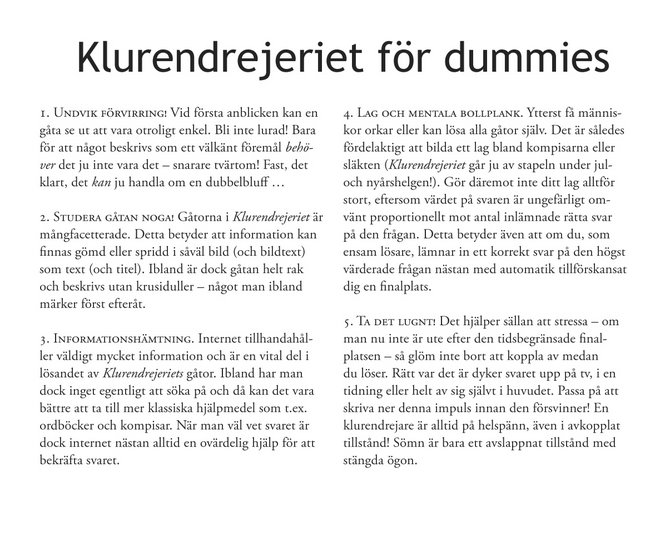
Här följer en engelsk översättning av den sista delen av Klurendrejeriet för dummies som gavs ut på svenska (och återfinns längst ner på denna blogg) i samband med Klurendrejeriet® mini förra året. Follow my advice and you will succeed!
Here is the English translation of the suggestions given in Klurendrejeriet® mini last year, titled:Klurendrejeriet for dummies"5. TAKE IT EASY! There is little to be gained by rushing - unless one is after the time-limited final seat - so do not forget to relax while you solve. Before you know it, the answer pops up on tv, in a magazine or spontaneously by itself in your head. Make sure to write down this impulse before it goes away! People solving riddles in Klurendrejeriet® are always on their toes, even in their when not solving actively. Sleep is just a relaxed state with closed eyes."Note: There is no time-limited final seat in Klurendrejeriet® mini, but your answers need to be sent in by 13 October. This was the last part of Klurendrejeriet för dummies to be translated. You can find the Swedish original on the bottom on the blog and the four first parts by clicking on the label dummies just below this text.
Detta är en lektion i svenska för icke-svenska deltagare i Klurendrejeriet® mini, främst avsedd för att hjälpa till där språkförbistring sätter käppar i hjulet.
 One equals the other?
The Swedish language may have many quirks and traps one can fall into, but no other is as clear as the number one. There are two separate words for one in Swedish, en and ett corresponding to the two main grammatical genders the language has. The former one is called n-genus (also reale or utrum) as it uses the suffix -n, whereas the latter one is called t-genus (also neutrum) with suffixes -t. When learning Swedish, one normally learns the genus of the word at the same time. There are a few very fuzzy rules though these are really not worth remembering. To complicate matters slightly, the plural form of t-genus words is oftentimes -n (if it is not a null plural), but that is different lesson entirely!Let us put this new Swedish knowledge to the test! In a Swedish rebus, such as the one in question 1. EXPRESSIONS FOR IMPRESSIONS in Klurendrejeriet® mini, it is impossible even for a native Swedish speaker to know beforehand if it should be read en or ett. Once reached, however, the correct answer only yields one solution and the other turns into gobbledygook. Hopefully this can shed some light on the problem non-Swedish participants might have with Swedish.
Här följer en svensk översättning på kommentaren som kan läsas i original här.
Non-Swede sa: "Hej! Det här är rena svenskan för mig. Kommer det att komma några mer 'internationella' ledtrådar?"
Above is the Swedish translation of a comment originally posted here.
Här följer en engelsk översättning på kommentaren som kan läsas i original här.
Here is the English translation of a comment originally posted here.
JoHo sa: "Oh, I guess congratulations is in order! Celebrate? How about me singing 'Lang zal hij leven' here at home? Or perhaps we can get som new exciting PICTURE (that has to do with the mini-Klur) to look at?"
Här följer en engelsk översättning på kommentaren som kan läsas i original här.
Here is the English translation of a comment originally posted here.
JoHo said: "I may be responsible for Gothenburg, have a klur friend there! :D"

 "Two Bs or not two Bs, that is the question."




 Posts
Posts