Kungsträdgården är ett nav kring vilket mycket av Stockholms nöjesliv kretsar och utgör även ena änden av tunnelbanans blå linje. I denna park, som precis som namnet gör gällande tidigare användes för trädgårdsodling, står statyer av kungarna Karl - såväl XII (sedan 30 november 1868) som XIII (sedan 5 november 1821). Bilden är en visualisering av det skämtsamma stockholmska uttrycket "ett lejon mellan fyra krukor och en kruka mellan fyra lejon", då den senares insats bedömdes som mindre heroiska än den tidigares. Rätt svar: Karl (37 poäng)
Karl den 13 ... och 12
Kungsträdgården in the center of Stockholm is not only the end of the blue metro line, it is also the home of statues of two times Karl, Charles XII and Charles XIII of Sweden. The rebus picture is a visualization of the jocular Stockholm expression "ett lejon mellan fyra krukor och en kruka mellan fyra lejon" ("a lion surrounded by four pansy pots and a pansy pot surrounded by four lions"), as the latter was not regarded as brave as the former. Correct answer: Karl (37 points)
Har du problem med årets frågor och du känner att tiden håller på att rinna ut? Var då inte rädd - chansa på något rimligt! Läs frågan och kolla vad som krävs för dina sex svar (en bokstav, en siffra, etc.) och skicka in det för det kan räcka långt! Kom ihåg att det finns andra som utsätts för betydligt större prövningar, såväl påhittade som "verkliga". Om detta inte hjälper, slappna då av med en Bergman-rulle?
Anar öråd? Lost it yet?
Are you experiencing problems with the questions this year, while time is running out? Then shake off your fear - take your best guess! Read the question and check you need for your six answers (a letter, a number, etc.) and submit that because it might be enough! Remember that there are others that are facing much worse challenges, including both made-up and "real" ones. If that does not help, why not relax with a Bergman movie?
Den svåraste av alla frågor i Klurendrejeriet® 2008 var jakten på det mest fulländade ordet i svenska språket i fråga 11. DUBBELGRUBBEL! Ordet inuti kan med hjälp av de ledtrådar som gavs i texten bilda orden i (på två olika sätt), in, ini, uti, in och ut, samt inuit. Om detta inte var nog, kunde man följa den sista meningen till punkt och pricka: "Skriv ner den mittersta bokstaven i denna fyrdubbelgrubbliga språkjuvel." Den mittersta bokstaven i "denna fyrdubbelgrubbliga språkjuvel" är den som efterfrågas i det sökta ordet! Rätt svar: u (45 poäng)
IN & UT!
The hardest question of all those that appeared in Klurendrejeriet® 2008 was the hunt for the most complete word in the Swedish language in question 11. DOUBLE TROUBLE! The word inuti, meaning within, can form all the words hinted in the text: i (in two different ways), in, ini, uti, in & ut, and inuit. As if this was not enough, one could simply follow the last sentence to the letter: "Even if you are not a native Swedish speaker, you should not have any problem writing down the middle letter in this linguistic gem." The middle letter in "this lingustic gem" is the same one that we were looking for! Correct answer: u (45 points)
Här följer den åttonde delen i Klurbloggens lektion om Sverige och svenska företeelser. Håller du inte med? Besvara då detta inlägg med en kommentar.
The official start of Sweden.
Sweden is often referred to as being a small country, when in fact it is the 55th largest country area-wise. The country streches from Smygehuk in the south (55°20'13" N, 13°21'34" E) to Treriksröset in the north (69°03'36" N, 20°32'55" E), as well as the islets Stora Drammen in the west (58°55'43" N, 10°57'27" E) and Kataja in the east (65°42'0" N, 24°10'0" E). When it comes to population, Sweden drops to 88th place with its 9.1 million inhabitants but that is still in the top half. The combination between the two, however, causes Sweden to end up with of a mere 20 persons per square kilometer. Then again, Sweden's two land-linked neighbours, Finland and Norway, both have an even lower population density at 15.5 and 12 person per square kilometer, respectively. No wonder there is still true wilderness in the northern part of the Scandinavian Peninsula!
Här följer den sjunde delen i Klurbloggens lektioner i svenskakunskaper för nybörjare. Håller du inte med kan du alltid kommentera detta inlägg.
Half a crown for the chest?
The Swedish currency has been the same since 1873 when krona (pl. kronor) replaced the previous riksdaler. The change to krona [crown] was part of the Scandinavian Monetary Union, where also Denmark (and thus also Iceland, Greenland, and the Faroe Islands) and later Norway took part. The union lasted until World War I, but even after a formal split, all of the countries retained the name of the currency. The correct name for the Norwegian and Danish kind, however, is krone (pl. kroner) and in Iceland it is called króna (pl. krónur). A common abbreviation in all countries is kr. and the Nordic crowns are all split into 100 öre (øre and aurar, respectively). The singular form for aurar is eyrir. Since neither Denmark nor Sweden opted to join the euro project and Norway and Iceland are not even part of the European Union, the different crowns will remain the first and foremost legal tender in the Nordic countries for quite some time.
Det har blivit dags för den sjätte lektionen i Klurbloggens svenskakurs. Håller du med eller har du en annan uppfattning? Oavsett svar, går det bra att kommentera detta inlägg.
[shuurkort] or [keurshurt]?
We have previously dealt with the Swedish letters å, ä, and ö - here is a bit of insight on the rest of the vowels (and for the Swedish ones too for that matter) forming the 17 phonemes found in the language. Orthographically, the Swedish vowels are divided into two groups: hårda (hard ones: a, o, u, and å) and mjuka (soft ones: e, i, y, ä, and ö). The reason for these designations is simple: most of the time the hard ones make the preceding consonant sound be harsher, whereas the soft ones offer a softer sound! The consonant or consonant pairs affected by this are mainly c, k, g, and sk. Examples of hard consonants are cola [k-], kappa [k-], garn [g-], and skalle [sk-], whereas their softer counterparts would be found in citron [s-], käpp [ch-], gärna [y-], and sked [sh-]. A word of caution is in place, as some borrowed words have retained their pronunciation, such as kör [choir, k-] which should not be spoken with kör [(she/he) drives, sh-]. There are also exceptions to the general rule, but those are better learned than explained here. Now you should be able to answer the caption above!
Vilken månad september blev till slut för Klurbloggen! I snitt kom 26 unika besökare från en hel hop med länder hit och läste detta information om allt från rockband till svensk reklam. Här följer september månads sammanfattning av alla relevanta (öppna) ledtrådar som getts hittills i Klurendrejeriet® mini sedan den senaste sammanfattningen för augusti (1 september):
Tävlingen: Klurendrejeriet® mini (2007) Ledtrådar till 1. UTTRYCK FÖR INTRYCK: 24 september Ledtrådar till 2. ETT TU, BRUTE: 4 och 29 september Ledtrådar till 3. HANDUPPSTRECKNING: 12 och 29 september.
What a month September turned out to be! On average, 26 unique visitors came from a whole bunch of countries and read information ranging from rock bands to Swedish ads. Here is the September recap of all relevant (open) clues given so far in Klurendrejeriet® mini since the last one offered for August (1 September) - in case you have missed any - listed in order of appearance:
The contest: Klurendrejeriet® mini (2007) [English translation] Clues to 1. EXPRESSIONS FOR IMPRESSIONS: 24 September Clues to 2. ETT TU, BRUTE: 4, 29 and 30 September Clues to 3. HAND IN HAND, LINE BY LINE: 12 and 29 September
Här är ytterligare en lektion i svenska för våra icke-svenska deltagare i Klurendrejeriet® mini. Om du har några kommentarer, skriv ett inlägg (eller två!) med meddelandefunktionen.
One or two?
Here is the fifth lesson in Swedish for beginners especially for the participants of Klurendrejeriet® mini. We have previously covered the magic number one in Swedish, and this time we are doing it to two too! In modern Swedish, the word primarily used is två [roughly pronounced: twoh]. As always, there are a few exceptions found in standing expressions or archaic ways of expressing some type of dualism (a few of these are listed below, where the two counterpart is in the translated explanation is in italics). There is no grammatical dual (dualis) per se in modern Swedish, but some remnants can still be seen in words like ögon (eyes), öron (eyes), and pairing words like båda and bägge (both meaning both).
de unga tu (the young couple) ett, tu, tre! (one, two, three! [expressing a sudden event])
tvenne folkvisor (two folksongs) tvegifte (bigamy) tveeggad (double-edged [nowadays often meaning "having advantages and disadvantages"])
Här nedan följer den fjärde delen i Klurbloggens nybörjarkurs i svenska, som erbjuds för att göra Klurendrejeriet® tillgänglig för de som inte har svenska som modersmål.
Island in the stream?
In this session of Swedish 101, we will take a look at the three Swedish letters Å, Ä, and Ö. Unlike German, these characters are treated as separate letters and not just umlauted versions of A and O, which is essential when for instance sorting entries in a dictionary or train timetable. You will not find the city of Härnösand listed in the "Har" or "Haer" section, but rather in its own order under "Hä". The letters are placed last in the Swedish alphabet (... y, z, å, ä, ö), and all being vowels, they bring the total to nine separate vowels in the language (y is also counted as a vowel). Ä by itself does not mean anything, but å is the Swedish word for stream and ö is the Swedish word for island.
Kapp-Ahl har lockat till sig ytterligare en Hollywood-stjärna till sin You Look Great-kampanj. Den som sägs gilla deras budskap denna gång är det ingen mindre än Richard Gere, som genom Pretty Woman och American Gigolo har haft länkar med Sverige förut. Den sistnämnda innehåller en "berömd" scen där vi får höra hans försök till svenska. På tal om det erbjuder vi en ny lektion i Swedish 101 inom kort, allt för att underlätta lösandet av Klurendrejeriet® mini (länk till höger) och kommande Klurendrejeriet® 2008.
Do I look gereate?
Swedish clothing warehouse Kapp-Ahl has revealed its latest Hollywood addition to their You Look Great campaign. This time it is no other than Richard Gere, who trough Pretty Woman and American Gigolo have had connections with Sweden before. The latter includes a "famous" scene where we hear Mr. Gere try to speak Swedish. Speaking of trying, we will offer a new Swedish 101 lesson shortly to simplify any Klurendrejeriet® mini (link to the right) and Klurendrejeriet® 2008 solving efforts.
Detta är tredje delen i Klurbloggens kurs i svenska. Håller du inte med eller vill du lägga till något? Svara då med en kommentar!
Pippi on a Swedish commemorative coin (2002) for the 95th anniversary of the birth of Astrid Lindgren
There are many famous Swedes in the world, both real and fictional ones, but the first one listed in many surveys is often Astrid Lindgren's fantastic creation Pippi Longstocking (Pippi Långstrump in Swedish). Her name was taken out of the blue(?) by Astrid's 7-year old daughter Karin as she lay sick in pneumonia (1941). Pippi has since become an integral part of any given Swedish childhood, and also in many other parts of the world. Pippi's name has been used as a symbol of everything Swedish, ranging from (but not limited to) her supposed anarcho-socalist values to strong independent women. A part of understanding Swedish is thus understanding Pippi and her values, as seen through the eyes of a 9-year old girl (whether you like it or not). (Note: This lesson in Swedish 101 has very little to do with Klurendrejeriet® mini, other than simply stating that sometimes the answer is obvious to a child, whereas grown-ups tend to complicate things!)
Här följer en svensk översättning på kommentarerna som kan läsas i original här:
Jonas sa: "Homonym är den språkterm du borde använda eller . Jag ber om ursäkt om detta har diskuterats på denna blogg."
Mr. Klur sa: "Ja, denna typ av likhet ligger under vad man normalt kallar homonymi. Det finns däremot många olika typer av homonymi vilket förklarar varför en förklaring av den aktuella typen gavs. De ord som diskuteras i bloggmeddelandet skulle lingvistiskt sett ofta kallas heteronymer eller heterofoner, eftersom termen homonym är aningen tvetydigt. Tack för meddelandet! Och för framtida kommentarer: det finns ingen anledning att be om ursäkt för någon avgiven kommentar på denna blogg!"
Above is a Swedish translation of the comments originally posted here.
Detta är andra delen i Klurbloggens kurs i svenska. Håller du inte med? Svara då med en kommentar!
There are many words in Swedish that are spelled the same way, but mean completely different things based solely on the fact that they are pronounced differently (as if they had a grave/acute accent), a so-called pitch accent. An excellent example is the pair anden (the duck) and anden (the ghost), and another is planet (planet) and planet (the airplane). The latter one can be distinguished using grammar rules, whereas the former is harder to see though context should make it obivous. To complicate matters, there are a few words that make use of the accents, for instance ide (lair) and idé (idea), but it would be wrong to write out accents for words that should not have any (except in the strict way of showing pronunciation).
En en or two ...?
Even one of the words for one, en, has a pitch accent friend in the word en (jupiper tree). And to make it even more odd, this word is an n-genus word, which makes a juniper tree be an excellent way of practicing both of the Swedish 101 rules featured on Klurbloggen so far: en en!
Du har väl inte glömt bort att lägga din röst på den fråga du vill ha hjälp med? Det finns fortfarande gott om tid att göra det här.
You have voted, right? If that is not the case, you can still do so here. Also, being a non-native Swedish speaker, you can also suggest something that you wish to have explained in terms of grammar, culture or general knowledge. For that input, you can leave your comment here.
Detta är ett meddelande till alla icke-svensktalande deltagare i Klurendrejeriet® mini.
This post is directed especially to all non-Swedish participants of Klurendrejeriet® mini. What would you like to have explained in terms of the Swedish language? Your comments to this post will be the foundation of the next installment of Swedish 101 (coming soon to a blog near you).
Detta är en lektion i svenska för icke-svenska deltagare i Klurendrejeriet® mini, främst avsedd för att hjälpa till där språkförbistring sätter käppar i hjulet.
One equals the other?
The Swedish language may have many quirks and traps one can fall into, but no other is as clear as the number one. There are two separate words for one in Swedish, en and ett corresponding to the two main grammatical genders the language has. The former one is called n-genus (also reale or utrum) as it uses the suffix -n, whereas the latter one is called t-genus (also neutrum) with suffixes -t. When learning Swedish, one normally learns the genus of the word at the same time. There are a few very fuzzy rules though these are really not worth remembering. To complicate matters slightly, the plural form of t-genus words is oftentimes -n (if it is not a null plural), but that is different lesson entirely!
Let us put this new Swedish knowledge to the test! In a Swedish rebus, such as the one in question 1. EXPRESSIONS FOR IMPRESSIONS in Klurendrejeriet® mini, it is impossible even for a native Swedish speaker to know beforehand if it should be read en or ett. Once reached, however, the correct answer only yields one solution and the other turns into gobbledygook. Hopefully this can shed some light on the problem non-Swedish participants might have with Swedish.
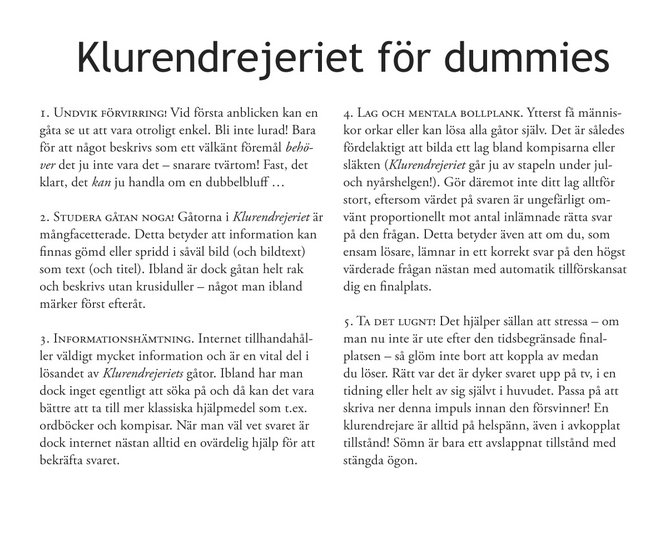
Klurendrejeriet® är en prisbelönt, årlig tävling där det gäller att ha ett gott bildsinne, navigera förbi luriga ledtrådar och söka information. Tävlingen är öppen för alla och har sedan 2006 en officiell engelsk översättning.
Klurendrejeriet® is an awarded, annual contest a good visual sense, the ability to navigate through maze-like clues and seek information is useful. The contest is open to everyone who wants to participate, where international contestants have enjoyed an official English translation since 2006.




 Posts